Cyclone country is a phrase people use for the north, as if the wind were a regional character rather than a design load. In the Australian Standards it has coordinates. Wind regions C and D, in AS/NZS 1170.2, are the cyclonic and severe-cyclonic coastal belts. Region D is the harsher, narrower strip. Region C is wider. A house in those belts is supposed to be tied to the ground in a way a house in most of the south is not.
A pre-purchase inspector in Cairns, Townsville, Darwin, Broome or the smaller towns in between is looking, among other things, at whether that tying still exists. They are looking from a manhole, with a torch, at connections someone made in a hurry in 1979 or in a more ordered way in 2006. They are not issuing a wind rating. They are not promising the roof will be there in March. They are doing the visual job AS 4349.1 actually describes, in a landscape where the most expensive defect is often above your head.
This is not a structural specification, and it is not advice about whether to buy a particular high-set fibro in the next wet season. It is an account of what the roof is being asked to do, and of what a careful stranger can see in an hour.
Why the roof is the argument
Cyclonic wind does not only push. It lifts. The roof cladding, the battens, the trusses or rafters, and the walls are a chain. The chain is only as good as the connections: screws or nails into battens, straps or rods from the roof frame into the walls, and from the walls into the stumps or the slab. If the cladding peels, the rest of the house starts to come apart in a different weather.
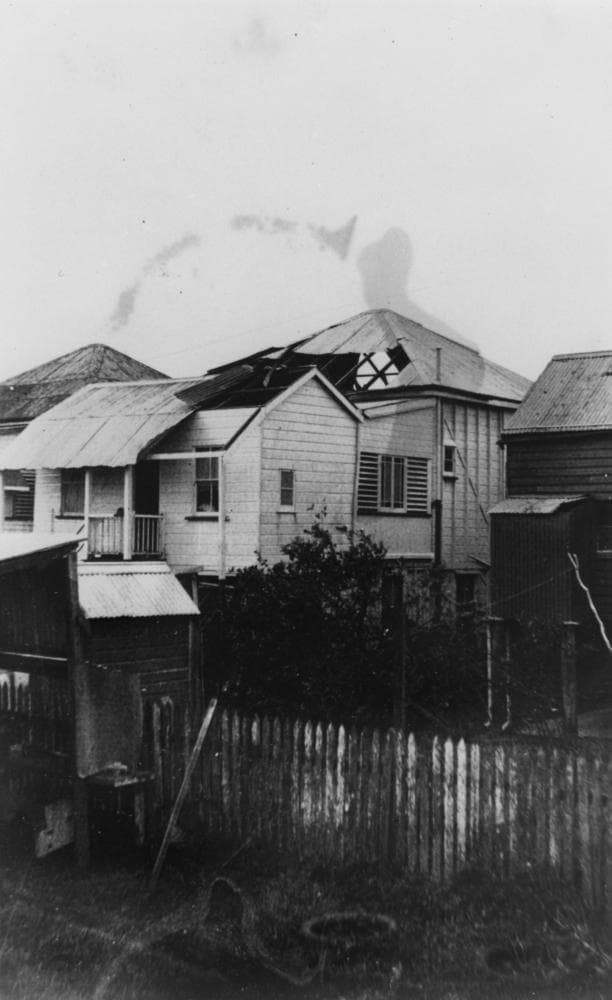
Darwin after Cyclone Tracy, Christmas 1974, is the national lesson that still sits in the code. The city lost the majority of its houses. The reconstruction, and the cyclone-testing culture that followed, changed fasteners, tying, and the idea that a tropical house could be a light box sitting on the wet season. Far North Queensland has its own archive — Winifred, Larry, Yasi, and the slower attrition of lesser crossings — and the photographs from Cairns in 1927, roof sheets folded back like a tin of sardines, are older than the code and not out of date as a picture of the mechanism.
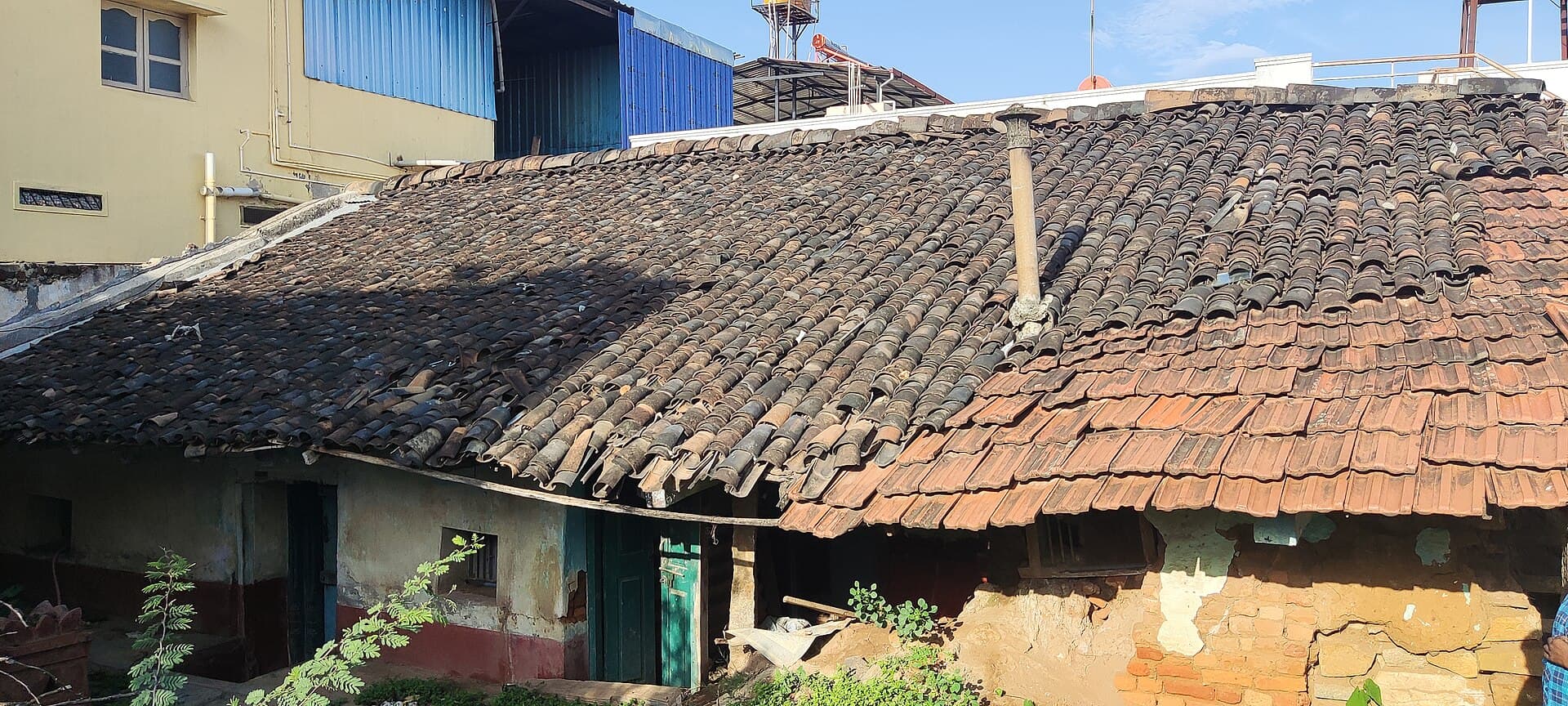
Older houses in FNQ and the Territory were often built for heat and rain, not for that lift. High-set timber, light cladding, generous eaves, and a roof that could be repaired after a season were rational choices in one climate story. They are incomplete in another. Many have been strengthened. Many have been extended with a carport, a patio roof or a second storey that was not part of the original chain. The inspector is looking for the chain, and for the places someone interrupted it.
What tying down looks like when you can see it
In the roof space of a house that has been properly considered, you may see metal straps wrapping rafters or trusses and disappearing into the top of the wall. You may see cyclone rods — threaded steel that runs from the roof down through the frame toward the footings — with nuts and plates that can be inspected, and sometimes tightened, from below. You may see batten screws, not nails, holding the battens to the rafters, and screws with cyclonic washers holding the sheeting.
You may also see nothing of the kind. You may see nails, a few bent straps that stop short, a later air-conditioner that has cut a strap, or rust that has turned a rod into an ornament. You may see a beautiful new ceiling and no safe way into the space above it. All of these are reportable. None of them, alone, is a rating.
Batten screws versus nails is one of those details that sounds pedantic until the first sheet leaves. Nails rely on friction and on a timber that has not split or rotted. Screws have a better conversation with uplift. A house that was re-roofed after Larry or Yasi may have the screws and still have the original nails lower in the chain. The new sheeting is not the whole roof. Roofs, gutters and stormwater are one system in the rain and a different system in the wind. The inspector has to look at both, and the report should not treat a tidy gutter as a tied-down roof.
Rust is the quiet tropical defect. Salt air, leaking valleys, and a roof space that cooks and sweats will eat straps, screws and rod threads. A connection that was adequate in 1991 can be decorative in 2026. Flashlight photographs of orange metal at the top plate are not a laboratory test. They are a reason to get an engineer or an experienced builder before you treat the house as “post-code”.
Roller doors, debris, and the hole in the box
Cyclone damage reports return, with a kind of grim loyalty, to garage roller doors. A wide door is a large, flexible panel. Under pressure it bows, leaves the tracks, or takes the opening with it. Once the hole exists, internal pressure rises and the roof, which was designed as part of a closed box, is working in a different experiment. Rated doors, locking strategies and debris screens are the industry’s answer. Many older garages have none of these. Many newer ones have a door that was the cheaper option at the time.
Debris is the other half of the same physics. Roof sheets, branches and the neighbour’s trampoline become projectiles. Screens on openings, laminated glass, and the absence of loose objects in the yard are preparedness as much as construction. A pre-purchase inspector can note a roller door that is clearly a domestic slat in a region C garage, or a patio roof that is a sheet of metal on slim posts. They cannot crash-test it.
The site matters. A house with a clear upwind fetch over water or cane is not the same as a house in a dense suburb of other houses. The standard wind regions already assume a lot. Local exposure is still a fact the report can mention without pretending to be a wind engineer.
Older FNQ and NT houses, and the work that has been done since
A 1960s high-set in Townsville, a Darwin house that survived Tracy and was repaired, and a 1980s Broome fibro are not one building type. They share a climate and a set of later government programs that tried, with mixed thoroughness, to get rods and straps into houses that had never seen them.
Some of that work is documented: a council file, a plaque in the subfloor, a seller who still has the invoice. Some of it is folklore. “It’s been cyclone-proofed” is a sentence that should never be left alone in a contract. Ask what was done, in which year, by whom, and whether anyone has looked at the rust since. The inspector can confirm that rods are present and that straps are visible. They cannot confirm that the rods reach a footing that still exists.
Alterations are where good original work goes to die. A raised roof for a loft, a removed internal wall, a new opening for a boat, a solar array fixed through the sheeting without thought for the batten below — each of these can be harmless and each of them can be the place the chain breaks. New builds versus established homes is a different article, but the cyclone version of that distinction is sharp. A 2018 volume-built house in a declared region should have a paper trail. A 1972 house with a 2003 patio may have a paper trail that stops at the patio.
The Territory has its own reconstruction memory and its own housing stock, including elevated houses that do the wet season well and the wind only if the connections were designed. Queensland’s coastal towns have more of everything: more houses, more alterations, more inspectors who have seen a stripped roof from the street and would like not to see one from the manhole.
What the inspector is not certifying
It is worth being blunt, because the wish is so common. An AS 4349.1 report is not a certificate that the building complies with the wind code, the NCC, or the local planning scheme’s cyclone overlay. It is not a structural engineer’s inspection. It is not a residual-current device for acts of God.
If you need a certification — a lender is asking, an insurer is asking, or you are about to add a storey — you need the person who does that work, the drawings if they exist, and probably some opening up. The visual inspector should say when they have reached the edge of their method. A report that says “appears consistent with cyclonic construction” without describing a single connection is a report that has run out of torch battery, or courage.
Safety hazards still belong in the document. A roof sheet that is already lifting, a rod hanging free, a patio that has pulled from the wall, are not academic. They are the present tense.
Insurance, age, and the market’s short memory
Insurers in the north have been through enough seasons to be specific. Year of construction, roof type, and whether the house has been upgraded sit in questions that a southern buyer may never have seen. Some older houses are difficult to insure on terms that make the purchase sane. Some newer houses are straightforward until the excess is explained. This is not financial advice. It is a warning not to leave the insurance call until after the auction.
Age is a blunt instrument and still a useful one. Pre-Tracy Darwin, pre-1980s Queensland coastal, and any house whose roof was last seriously touched before the post-Yasi tightening, deserve a longer look in the roof space than a 2016 build with a clean file. Blunt instruments miss the 1994 house that was built carefully and the 2010 house that was not. The inspector’s photographs of the connections are better than the year on the title.
Debris, shutters and a garage door will not appear as line items on every policy, but they appear in the claims. A buyer who treats them as lifestyle accessories is reading the wrong catalogue.
The roof space is where cyclone country stops being a travel phrase. Either the straps are there, or they are not. Either the rust is a stain, or it is the connection.
How to use the inspection without asking it to be an engineer
Brief the inspector that the roof connections matter to you. Ask them to photograph straps, rods, batten fasteners and any rust at the top plate. Ask them to say, plainly, whether they got into the roof. If they did not, the cyclone conversation has not started, and you should not bid as if it had.
If the photographs show a mixed, rusty or absent set of connections, the next call is a structural engineer or a builder who does this work in this town — not a second inspector who will write a longer version of the same limitation. If the house is new enough to have certifications, read those before you pay anyone to guess.
The climate and regional risk of the north is not only wind. It is termites, it is rain that finds every penetration, and it is a reconstruction culture that has learned and forgotten in cycles. The roof is the part of that culture you can still see with a ladder. Use the ladder. Then read the report as a visual document, which is all it has ever been, even when the sky to the north is a colour you do not like.