Australia has a termite fauna that treats houses as an extension of the forest. The species that do the expensive work are mostly subterranean: they nest in the soil or in a tree, they need a moisture path, and they travel to cellulose in the building. The inspection problem is that they do this out of sight. A competent timber pest inspection is therefore a search for evidence and for the conditions that make evidence likely, not a promise that a colony is absent.
This piece sits in the pest and timber hub. It is about subterranean termites in dwellings, the limits of a visual inspection, and the sentences inspectors write when they have seen mud, heard a hollow skirting, or found a garden bed built against a slab. It is not a treatment manual, and it is not a substitute for timber pest reports versus building reports.
The insects that actually matter in houses
Buyers meet termites as a single word. Inspectors meet genera.
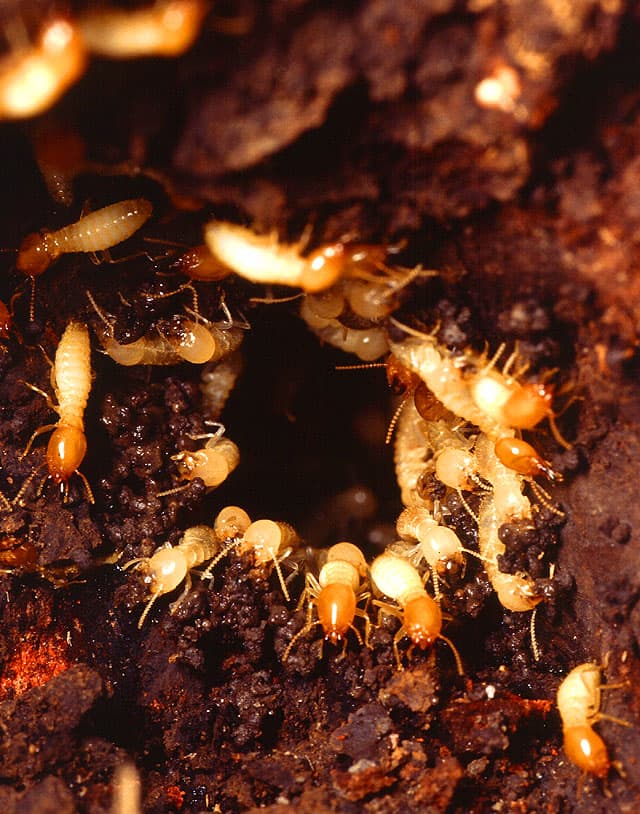
Coptotermes acinaciformis is the species most often blamed for structural damage in Australian houses. It is widespread, aggressive in timber, and comfortable in urban soil. A colony can be in a tree on the nature strip or under a slab. The damage is usually hidden until a skirting sounds hollow, a door drops, or a pest inspector’s probe goes through a jamb.
Other Coptotermes species, including some with more tropical habits, show up in the north and in parts of the west. The Formosan termite is the international celebrity; it is not the usual Australian house story. The local Coptotermes are enough.
Schedorhinotermes species are also subterranean and also eat houses. They are often discussed in Queensland and northern New South Wales. They do not care that the vendor described the house as “brick”.
Nasutitermes is a different problem. Some species build obvious arboreal or mound nests and feed on weathered timber, fences and the odd decorative hardwood more than on the concealed frame. An inspector who writes “Nasutitermes nest in the eucalypt, no evidence of attack in the dwelling at this inspection” is not being casual. They are separating a landscape insect from a structural one. The tree may still need management. The house may still need a Coptotermes inspection. They are not the same sentence.
Drywood termites exist in Australia and are a smaller, more localised pre-purchase issue than the subterranean group. White ants, borers and fungal decay covers that distinction, and the way “white ant” is used as a folk name for all of it.
Climate, but not a climate alibi
Maps of termite hazard in Australia run, broadly, from relentless in the north to lower in the far south, with the coast more active than some inland deserts. That map is useful for builders designing a barrier. It is a poor reason for a buyer in Melbourne or Hobart to skip an inspection.
Coptotermes acinaciformis has been recorded across an unhelpfully large part of the continent. Melbourne’s inner north, Adelaide’s foothills, Perth’s suburbs, the ACT, Launceston and the New South Wales tablelands all produce real reports of live activity. The difference is frequency and ferocity, not absence.
Northern Australia — Darwin, Cairns, Townsville, Broome, the Queensland coast, northern New South Wales — is high-risk in the everyday sense. Annual inspections after treatment are not an upsell in those markets. They are how you find out whether the barrier you paid for is still doing anything. Post-treatment inspections and pest certificates is the piece on what those bits of paper mean.
Slab houses and subfloor houses are different inspections
Suspended floors
A house on stumps, piers or dwarf walls gives the inspector a chance. They crawl or walk the subfloor and look at the soil, the stumps, the ant caps, the bearers and joists, the damp, the debris, and the underside of bathrooms. They look for mudding on piers, for damaged timber, for old workings that have been abandoned, and for the conducive conditions that make the next colony easy: poor ventilation, stored timber, wet ground, leaking wastes.
Ant caps — the metal plates between stump and bearer — are a detection device. If they are complete and projecting, termites crossing from soil to timber may have to build around them, which is visible. If they are missing, rusted through, bridged by a later pipe, or never installed on a 1970s renovation, they are not doing that job. Inspectors write this without romance. “Ant caps incomplete at the laundry. Bridging at the waste pipe. Recommend a timber pest management plan and rectification of bridging.”
Slab-on-ground
A slab house removes the crawl space and does not remove the termites. Coptotermes will exploit a crack, a service penetration, an edge that has been backfilled, a garage joint, or a path that has been poured against the wall. The inspector works from the inside — skirtings, door jambs, built-in joinery, the meter box, the hot-water cupboard — and from the outside along the slab edge.
A visible slab edge is a design feature in some termite-management systems. A garden bed built up over that edge is a classic conducive condition. So is a weephole filled with soil, a step that covers the joint, and a patio that was added without returning to the barrier design. Inspectors in the Queensland south-east and in Perth write versions of the same sentence every week: “Slab edge not visible along the western elevation due to garden soil. This condition conceals a common entry path. Recommend lowering soil and reinspecting.”
What AS 3660 is doing in the background
AS 3660 is the termite-management series. Part 1 deals with new building work: physical barriers, chemical barriers, and the combination of the two. Part 2 deals with existing buildings. A pre-purchase inspector is not certifying compliance with AS 3660. They are looking at whether a system appears to be present, whether it has been bridged or breached, and whether the durable notice — the sticker in the meter box that tells you what was done — is still there.
Physical barriers include graded stone, stainless-mesh systems, and construction details that force termites into the open. Chemical barriers include soils treated at construction and reticulation systems that can be recharged. Baiting systems sit in a different category: they are a detection-and-colony tool more than a perimeter in the old sense.
Buyers treat “the house was pretreated” as a clearance. Pretreatment is a moment in 2011, or whenever the slab was poured. Gardens, paths, and a decade of irrigation change the soil. The inspection is of the house as it stands.
What a visual timber pest inspection can see
AS 4349.3 sets the method. The inspector looks at accessible timber and at the conditions around it. They use sight, a probe, a sounding tool, sometimes a moisture meter, sometimes a thermal camera as an aid. They do not open every wall.
Mudding. Subterranean termites build shelter tubes of soil and faecal material. On a pier, along a foundation, behind a hot-water unit, in a roof space against a chimney, these tubes are the photograph that changes a purchase. Fresh, moist mud is a different finding from brittle, abandoned workings. Both get written. Only one means you have a live problem today. The abandoned workings still mean the house is in a landscape that has already hosted a colony.
Hollow timber. A skirting, jamb or window reveal that sounds empty, or that a probe enters, is evidence of damage. It may be historic. It may be live. The inspector will try to tell you which, and will recommend opening the cavity if they cannot.
Frass and kick-out holes. More typical of drywood termites and some borers than of Coptotermes, but they appear in reports and need a species-level reading, not a panic.
Conducive conditions. These are the findings that appear even on a “clear” report, and they are the ones owners can actually fix.
- Garden beds and soil against walls, covering slab edges or weepholes.
- Downpipes and air-conditioner condensate wetting a footing.
- Poor subfloor ventilation and stored timber under the house.
- Leaking showers and wastes that keep a wall wet.
- Tree stumps, sleeper walls and formwork left in the ground after a renovation.
- Bridging of ant caps and of physical barriers by later pipes and paving.
A report that lists five conducive conditions and no live activity is not a waste of money. It is a list of the reasons the next inspection may not be clear.
What it cannot see
The inspector cannot see inside a cavity brick wall, under a slab, behind a kitchen that has not been moved, or into a roof space that has no safe walkway. They cannot see a colony in the neighbour’s tree. They cannot tell you that no termite will arrive next summer.
They also cannot, in a standard visual inspection, give you a structural certificate for timber that has already been eaten. If a bearer is damaged, the next person is a builder or an engineer. The pest inspector’s job was to find the evidence.
Limitations must be written. “Subfloor inspection limited by low clearance at the eastern bay and by stored goods. Recommend clearing and reinspection.” If you proceed without that reinspection, you have bought the eastern bay as an unknown. In a high-set Queenslander that unknown is often the bathroom.
What inspectors actually write
A few sentences recur across capitals.
From a Brisbane Queenslander: “Active Coptotermes workings to the stump adjacent to the laundry waste. Mudding fresh. Recommend treatment by a licensed pest manager and a builder to assess the bearer. Subfloor moisture high. Ventilation poor.”
From a Perth double-brick: “No visible live activity in accessible areas. Slab edge concealed by paving on the north. Weepholes obstructed. Recommend exposing the edge and an annual inspection given the locality.”
From a Melbourne 1950s weatherboard: “Historic termite damage to a window reveal in bedroom 2, no live activity sighted. Damage may be old. Invasive inspection behind the lining would be required to determine extent. Conducive moisture at the adjacent downpipe.”
From Darwin: “Durable notice for a chemical barrier dated 2018 sighted in the meter box. No recharge record provided. Visual inspection only. Given the hazard zone, a licensed pest manager should confirm the status of the system.”
Notice what those sentences do not do. They do not say “termite free”. They do not quote a repair cost. They do not treat a brick house as immune.
State by state, without the folklore
Queensland. Highest everyday risk for many buyers. Combined building-and-pest is normal. High-set timber is a gift to the inspector if they are allowed under it. New slabs still fail at the edge when the landscaper arrives.
New South Wales. Coastal and northern NSW behave like Queensland. Sydney is not exempt. Western Sydney slab-on-ground houses hide activity at wet edges. Do not skip pest because the listing is a brick veneer in a good suburb.
Victoria. Lower hazard than Townsville, not zero. Buyers from interstate who skip pest in Brunswick or Geelong are repeating a myth. Older timber floors and wet subfloors are the story as much as tropical ferocity.
Western Australia. Termites are a mainstream inspection item in Perth and the south-west, not an afterthought. Double-brick does not save the roof frame or the kitchen.
South Australia. Present, under-discussed, and often found when a damp problem is investigated. Masonry and termites coexist.
Tasmania. Activity is real in parts of the state. Fungal decay is more common than catastrophic termite events, but a pest inspection still earns its fee, if only to separate rot from insects.
ACT. Frost and termites are not mutually exclusive. Inspect.
Northern Territory. Assume pressure. Barriers, annual inspections and a competent pest licence are part of owning the house, not extras.
A buyer’s checklist for the termite inspection
- Book an AS 4349.3 inspection, not a building inspector’s glance, unless the same person holds the right ticket and writes to the pest standard.
- Tell the inspector if you already have a treatment certificate. Ask them to inspect the house, not the paper.
- Have the subfloor, roof space and meter box opened. The durable notice lives in the box.
- Walk the slab edge with them if you can. If you cannot see it, neither can they.
- Treat conducive conditions as findings, not as padding.
- If they recommend invasive investigation, that means opening a lining, not hoping.
- Do not skip the inspection in a southern city because a relative has never had termites.
Termites are not a moral failing of the vendor and not a reason to treat every Queensland listing as radioactive. They are a biological fact about timber, soil and moisture. The inspection is how you stop that fact from being a surprise at the first summer after settlement.